

Microwave absorption prevents resonances and cross-coupling up to 100 GHz
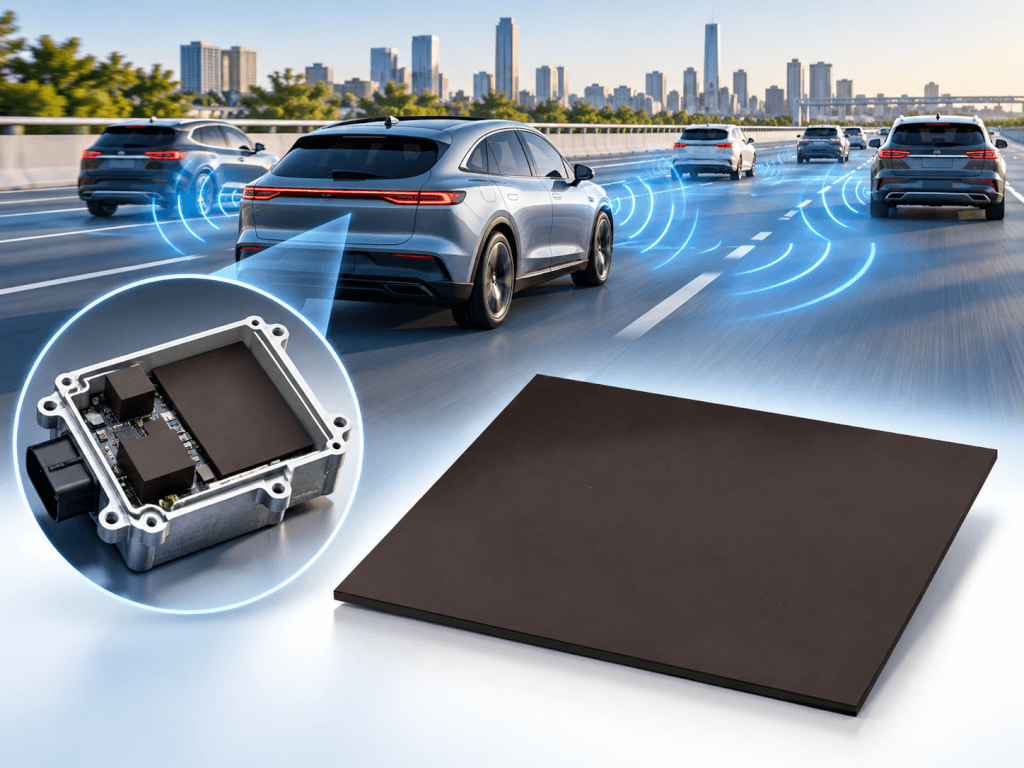
In compact high-frequency systems, metal enclosures, cavities and other structural components can cause unwanted microwave resonances and mutual coupling. In 77 GHz radar systems for ADAS driver assistance systems, this can affect signal integrity and therefore system operation. One solution is to locally absorb electromagnetic energy using a thin, flexible absorber material.
CHO-MUTE 9009 from Parker Chomerics is a carbon-filled silicone elastomer for frequencies from 10 to 100 GHz. The material absorbs up to 50 dB/cm and can be applied close to electronic circuits and metal surfaces.
Key properties:
- Frequency range: 10–100 GHz;
- Absorption: up to 50 dB/cm;
- Surface resistivity: >1 MΩ/square;
- Hardness: Shore A 50;
- Operating temperature: –50 to +160 °C.
The material is available as sheet in various thicknesses and can be supplied with an electrically conductive PSA adhesive layer.
For prototypes and series production, processes including die cutting, waterjet cutting and moulding are possible.
In addition to automotive radar, the material can be used in sensor enclosures, mmWave telecommunications equipment, and military and commercial radar systems.